General Chemistry Lab Manual: Article Plan (12/04/2025)
This manual streamlines introductory chemistry experiments, prioritizing student and staff safety through meticulous risk assessment and documentation. It aids analytical skills,
emphasizing precision, accuracy, and proper notebook techniques. Furthermore, it’s a collaborative effort, continually refined by faculty feedback, and designed for comprehensive learning.
Welcome! This lab manual supports your chemistry journey, offering tested experiments and crucial safety protocols. It fosters analytical thinking, demanding careful documentation and understanding of experimental procedures for success.
Purpose of a Lab Manual
A comprehensive lab manual serves as a vital guide throughout your general chemistry experience, meticulously outlining procedures for safe and effective experimentation. Its primary function is to provide a structured framework, ensuring consistency and reproducibility in results, while simultaneously minimizing potential risks to students, faculty, and staff.
Beyond safety, this manual cultivates essential skills – analytical thinking, problem-solving, and precise data recording – crucial for scientific inquiry. It details the purpose of each experiment, equipping you with the necessary background knowledge and pre-lab preparation. Furthermore, it facilitates post-lab analysis through targeted questions, reinforcing comprehension and critical evaluation of obtained data.
Ultimately, the manual isn’t merely a set of instructions; it’s a learning tool designed to enhance your understanding of fundamental chemical principles and foster a responsible, inquisitive approach to scientific investigation. It’s a culmination of expertise, continually refined to optimize your learning journey.
Safety Regulations and Procedures
Prioritizing safety is paramount in any chemistry laboratory, and this manual details crucial regulations and procedures to protect all personnel. Proper labeling of all chemicals and meticulous documentation of materials are fundamental aspects of risk assessment training, mandatory for both students and staff. Understanding potential hazards associated with each experiment is essential before commencing any work;
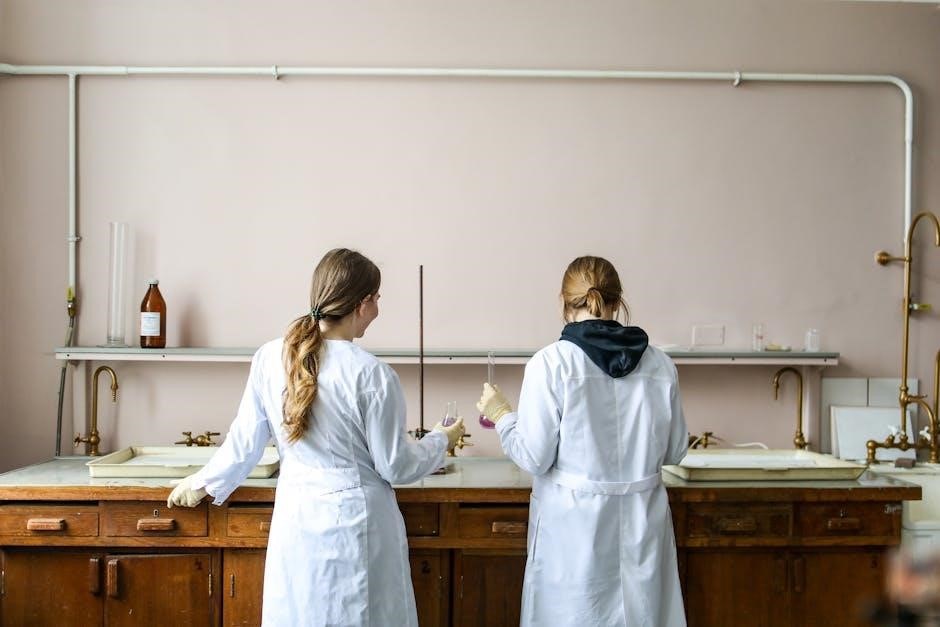
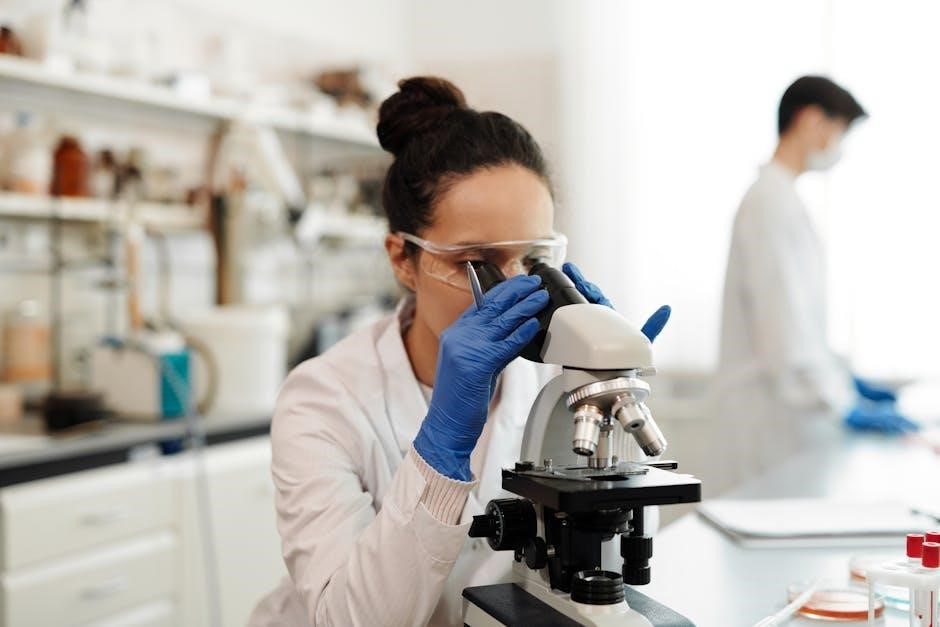
Always wear appropriate personal protective equipment (PPE), including safety goggles, gloves, and lab coats, as specified for each procedure. Familiarize yourself with the location and proper use of emergency equipment, such as fire extinguishers, eyewash stations, and safety showers. Strict adherence to waste disposal guidelines is also critical to prevent environmental contamination and ensure responsible laboratory practices.
Any deviation from established safety protocols must be immediately reported to the instructor. Remember, a proactive and cautious approach to safety is not just a requirement, but a responsibility.
Essential Lab Equipment and Their Uses
A well-equipped chemistry laboratory houses a variety of instruments, each serving a specific purpose. Beakers and flasks are fundamental for holding and mixing liquids, while graduated cylinders provide accurate volume measurements. Bunsen burners are utilized for heating substances, and hot plates offer controlled heating alternatives.
Spectrophotometers analyze light absorption and transmission, crucial for quantitative analysis, and balances precisely measure mass. Filtration apparatus, including funnels and filter paper, are essential for separating solids from liquids. Titration equipment, such as burets and pipettes, enables precise delivery of solutions for reaction analysis.
Understanding the proper use and maintenance of each instrument is vital for obtaining reliable experimental results and ensuring laboratory safety.

Fundamental Concepts in Chemistry
This section details core principles like accuracy, precision, and error analysis, alongside significant figures and units – crucial for effective lab work and reporting.
Accuracy, Precision, and Error Analysis
Understanding the nuances of accuracy and precision is paramount in any chemical investigation. Accuracy refers to how closely a measured value aligns with the true or accepted value, while precision indicates the reproducibility of measurements – how consistently you obtain similar results.
Error analysis is a critical component of responsible experimentation, allowing us to identify and quantify both random and systematic errors. Random errors, inherent in all measurements, can be minimized through repeated trials and averaging. Systematic errors, stemming from flawed equipment or procedures, require careful calibration and methodological adjustments.
This manual emphasizes the importance of diligently documenting potential sources of error and their impact on experimental outcomes. Students will learn techniques to calculate percent error and assess the reliability of their data, fostering a critical mindset towards scientific inquiry. Careful consideration of these concepts ensures the validity and integrity of experimental results.
Significant Figures and Units
Properly applying the rules of significant figures and utilizing correct units are foundational to clear and unambiguous scientific communication. Significant figures reflect the precision of a measurement, indicating the reliability of the digits reported. This manual provides a comprehensive review of these rules, covering addition, subtraction, multiplication, and division.
Units are equally crucial, providing context and meaning to numerical values. The International System of Units (SI) is the standard used throughout this lab manual, ensuring consistency and facilitating comparisons. Students will practice converting between different units and expressing results with appropriate dimensional analysis.
Ignoring significant figures or misusing units can lead to substantial errors and misinterpretations. Therefore, meticulous attention to these details is expected in all laboratory work and reported data. Mastering these concepts is essential for accurate data analysis and effective scientific reporting.
Laboratory Notebook Best Practices
A well-maintained laboratory notebook serves as a primary record of your experimental work, a crucial component of scientific integrity and reproducibility. This manual emphasizes the importance of detailed, chronological documentation, including dates, observations, procedures, and data. All entries must be written in ink, allowing for no gaps or alterations – errors should be corrected with a single line through the mistake, initialed and dated.

Pre-lab preparations, including outlining procedures and anticipating potential challenges, should be documented before commencing the experiment. During the experiment, record observations immediately, noting any deviations from the planned procedure. Post-lab analysis and interpretations should also be included, demonstrating critical thinking.
Your notebook is a legal document; therefore, clarity, accuracy, and completeness are paramount. Following these best practices ensures a reliable record of your scientific journey.

Experimental Techniques
This section details fundamental skills – measurement, solution preparation, and separation – essential for successful experimentation and data acquisition in general chemistry.
Basic Measurement Techniques
Accurate measurements form the bedrock of all experimental chemistry, demanding proficiency with various instruments. This includes mastering the proper use of balances – both analytical and top-loading – for precise mass determination, understanding significant figures in recorded values, and diligently noting units.
Volumetric glassware, such as burettes, pipettes, and graduated cylinders, requires careful handling to ensure accurate volume delivery; techniques like meniscus reading are crucial. Temperature measurement using thermometers, and timekeeping with stopwatches, also necessitate attention to detail.
Furthermore, students must learn to estimate uncertainty in each measurement and propagate these uncertainties through calculations. Consistent practice and adherence to established protocols are vital for minimizing errors and obtaining reliable experimental data, ultimately leading to meaningful conclusions.
Solution Preparation and Dilution
Creating solutions of known concentration is a fundamental skill in chemistry, requiring precise calculations and careful execution. This involves accurately weighing solutes and dissolving them in appropriate solvents, considering factors like solubility and temperature. Molarity, molality, and percent concentration are key concepts to master.
Dilution, the process of reducing a solution’s concentration by adding solvent, is equally important. The equation M1V1 = M2V2 is essential for calculating the volumes needed for accurate dilutions. Proper mixing is crucial to ensure homogeneity.
Students must understand the impact of using volumetric flasks and pipettes for accurate solution preparation and dilution, always documenting their procedures meticulously. Safety precautions regarding handling chemicals and disposing of waste solutions are paramount.
Filtration and Separation Techniques
Effective separation of components within a mixture is vital in many chemical experiments. Filtration is a common technique used to separate insoluble solids from liquids, employing filter paper and a funnel. Understanding pore size and appropriate filtration techniques is crucial for successful separation.
Decantation offers a simple method for separating liquids from settled solids, while extraction utilizes solubility differences to transfer solutes between immiscible solvents. Chromatography, in its various forms, provides powerful separation based on differing affinities for stationary and mobile phases.
Students will learn to select the most appropriate separation technique based on the mixture’s properties, documenting observations and ensuring proper waste disposal. Careful technique minimizes loss of product and maximizes purity.

Common Chemical Reactions & Experiments
This section details core reactions – acid-base titrations, redox processes, and spectrophotometry – providing hands-on experience with fundamental chemical principles and analytical methods.

Acid-Base Titrations
Acid-base titrations are a cornerstone of quantitative analytical chemistry, allowing for the precise determination of an unknown acid or base concentration. This experiment focuses on utilizing a standardized solution – a solution of accurately known concentration – to react completely with the analyte, the substance being measured.
Students will learn to select appropriate indicators, observe color changes signaling the equivalence point (where moles of acid equal moles of base), and perform calculations to determine the unknown concentration. Careful technique is crucial, including proper burette reading, slow addition near the endpoint, and multiple trials for improved accuracy. Understanding the underlying stoichiometry and the concept of neutralization is paramount for successful titration and data interpretation. Post-lab analysis will involve error analysis and a discussion of potential sources of uncertainty.
Redox Reactions and Electrochemistry
This section delves into the fascinating world of redox (reduction-oxidation) reactions, where electrons are transferred between chemical species. Students will explore the principles of oxidation states, balancing redox equations, and predicting spontaneity using standard reduction potentials. Electrochemical cells, both galvanic (spontaneous) and electrolytic (non-spontaneous), will be constructed and analyzed.
Experiments will involve measuring cell potentials under varying conditions, applying the Nernst equation, and investigating factors affecting electrode potentials. Emphasis will be placed on understanding the relationship between redox reactions and electrical energy. Furthermore, practical applications like corrosion and battery technology will be discussed. Data analysis will include calculations of cell potential, free energy change, and equilibrium constants, fostering a deeper comprehension of these fundamental concepts.
Spectrophotometry and Beer-Lambert Law
This module introduces spectrophotometry, a powerful analytical technique used to measure the absorbance and transmittance of light through a solution. Students will learn the principles behind the Beer-Lambert Law, which establishes the relationship between absorbance, concentration, and path length. Practical exercises will involve utilizing a spectrophotometer to determine the concentration of colored solutions.
Experiments will focus on creating calibration curves, analyzing unknown samples, and investigating the effects of various factors on absorbance measurements. Emphasis will be placed on understanding the limitations of the Beer-Lambert Law and potential sources of error. Furthermore, applications in quantitative analysis, such as determining reaction rates and equilibrium constants, will be explored. Data analysis will include calculations of molar absorptivity and concentration, solidifying understanding of this vital technique.
Data Analysis and Reporting
This section details organizing collected data, creating clear graphical representations, and structuring comprehensive lab reports with accurate results and insightful conclusions.
Data Collection and Organization
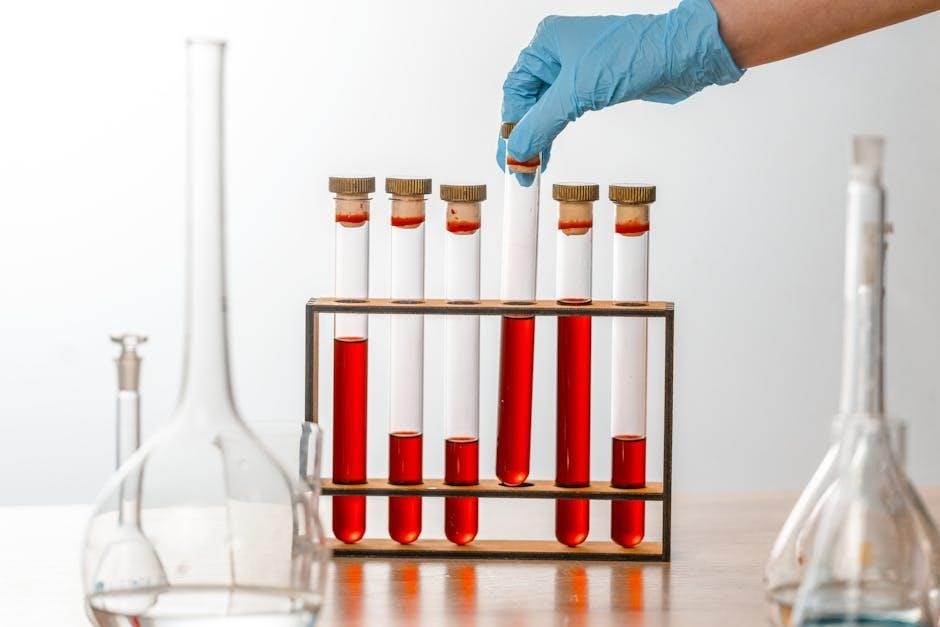
Effective data collection is paramount in any chemistry experiment, demanding meticulous recording of all observations and measurements. Utilize a well-organized table within your laboratory notebook to systematically capture raw data, including units and any associated uncertainties. Ensure clarity and legibility; ambiguous entries can compromise the validity of your results.
Article Views, tracking full text downloads since November 2008, highlight the manual’s accessibility. Proper organization facilitates subsequent analysis, enabling efficient identification of trends and anomalies. Consider employing spreadsheets or dedicated data analysis software for larger datasets. Remember to clearly label all data points and include descriptive headers. Consistent and thorough documentation is crucial for reproducibility and accurate interpretation, ultimately strengthening the scientific rigor of your work. This methodical approach is foundational to sound scientific practice.
Graphical Representation of Data
Visualizing data through graphs is essential for identifying patterns and trends often obscured in raw numerical form. Select the appropriate graph type – scatter plots for correlation, bar graphs for comparison, and line graphs for continuous changes – based on your experimental design. Clearly label all axes with variables and units, and provide a concise, informative title.
The manual emphasizes developing analytical skills, and graphical representation is a key component. Ensure scales are chosen to effectively display the data range, avoiding distortion or misinterpretation. Consider using error bars to represent uncertainties in measurements. Software like spreadsheets can greatly simplify graph creation. A well-constructed graph should communicate your findings clearly and concisely, supporting your conclusions and enhancing the overall impact of your lab report.
Lab Report Structure and Content
A comprehensive lab report is crucial for documenting your experimental work and demonstrating understanding. Typically, it includes an introduction outlining the experiment’s purpose and relevant theory, followed by a detailed methods section describing procedures. Present your results clearly, using tables and graphs as appropriate, and then engage in a thorough discussion interpreting your findings.
This manual supports the development of analytical and problem-solving skills through structured reporting. Include a conclusion summarizing key results and addressing any limitations. Pre-lab and post-lab questions, accompanying each experiment, reinforce comprehension. Proper documentation, including data organization and error analysis, is paramount. Adhering to a consistent structure ensures clarity and facilitates effective communication of scientific findings.
Appendix
This section provides essential guidelines for chemical waste disposal, emergency protocols, and valuable resources for continued learning in general chemistry.
Chemical Waste Disposal Guidelines
Proper chemical waste disposal is paramount for environmental protection and laboratory safety. All waste must be segregated into appropriately labeled containers – avoid mixing incompatible chemicals! Halogenated solvents, non-halogenated solvents, acids, bases, and heavy metal solutions each require separate disposal pathways. Solid waste, like filter paper contaminated with chemicals, should also be collected in designated containers.
Never pour chemicals down the drain unless explicitly authorized by your instructor; this can contaminate water supplies and damage plumbing. Always consult the Safety Data Sheet (SDS) for specific disposal instructions for each chemical. Ensure containers are tightly sealed and clearly labeled with the contents and date. Follow all local, state, and federal regulations regarding chemical waste management. Report any spills or improper disposal incidents immediately to your teaching assistant or lab supervisor. Remember, responsible waste disposal is a crucial component of ethical scientific practice.
Emergency Procedures

In the event of an emergency, swift and informed action is critical; Know the location of all safety equipment: fire extinguishers, eyewash stations, safety showers, and first aid kits. For chemical spills, immediately alert your instructor and contain the spill if possible, using appropriate absorbent materials. If a chemical comes into contact with skin or eyes, flush the affected area with copious amounts of water for at least 15 minutes.
In case of fire, activate the fire alarm and evacuate the laboratory following established procedures. For injuries, seek immediate medical attention. Familiarize yourself with the emergency contact information posted in the lab. Never attempt to handle a serious emergency situation alone. Report all incidents, no matter how minor, to your instructor or lab supervisor. Prioritize safety and remain calm during an emergency;
Resources for Further Learning
To expand your understanding beyond this manual, several excellent resources are available. Online platforms like Khan Academy and Chem LibreTexts offer comprehensive chemistry tutorials and practice problems. Your university library provides access to a wealth of textbooks, scientific journals, and databases. Consider exploring the Royal Society of Chemistry (RSC) and the American Chemical Society (ACS) websites for current research and educational materials.
Furthermore, many universities offer supplemental instruction and tutoring services. Don’t hesitate to utilize these resources if you’re struggling with specific concepts. Engage with your instructor and classmates – collaborative learning can significantly enhance your comprehension. Remember that continuous learning is key to mastering chemistry, and these resources provide a solid foundation for future studies.